
Now I Lay Me Down to Sleep
Safe death?

I was raised by parents of mixed religions. My father had distanced from his Jewish-turned-Ethical-Culturist heritage, and my mother from her New England Congregationalist roots.
We lived in New York State where the legal age for drinking was eighteen. My eighteenth birthday would mark both the emancipation from restrictions around drinking alcohol and the opportunity to choose a religion. An awkward twosome.
I was exposed to a little prayer as a child and I started saying it every night. It was around the time I was scared a fire would start under my bed and I would burn to death—I would die. (My mother later told me she had found me, my older brother, and a friend lighting matches in the attic when I was five. Her terror likely left me—appropriately!—fearful of fire.)
Now I lay me down to sleep.
I pray the Lord my soul to keep.
If I should die before I wake,
I pray the Lord my soul to take.
I didn’t want to die and repeating this prayer brought me some comfort. If I died, I’d be someplace safe after death, and I wouldn’t be alone. It doesn’t really make sense because I had no beliefs about a Lord who would take my soul, but some of the best stuff doesn’t make sense.
This prayer came to mind as I was shoveling out a few piles of manure from one of the horse stalls, a rare occasion because the horses live outside 24/7, coming into the barn only when the veterinarian or the hoof trimmer was due to arrive.
So why was I cleaning the stall? I had just found a very still but still-alive guinea fowl outside the guinea coop. The other twenty-one guineas had gone to roost, but he had not. He was lying on the ground after dark. A guinea doesn’t do this unless it is a hen sitting on a pile of eggs.
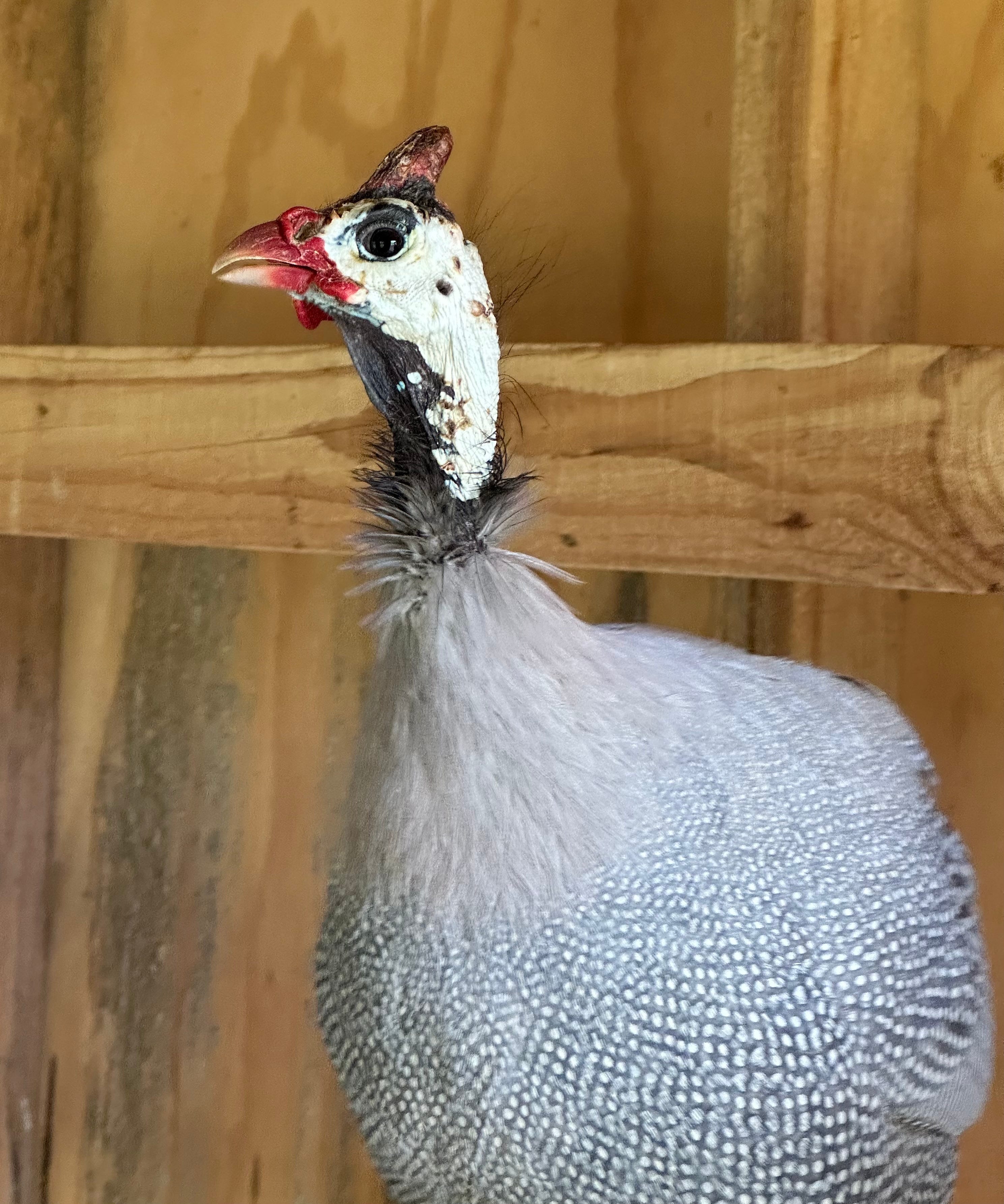
Typical of me finding an animal in distress, I picked him up, brought him to the water bowl, and made him drink by dipping his beak in. Must be thirsty is my first thought with injured animals as if water would cure all ailments. I wanted it to be as simple as a thirsty bird after a long hot day—all he would need is a drink of water.
Although I didn’t know if he’d live or die, I did know he was easy prey for the local owl if I left him there. I brought him into the barn, set him on clean shavings, and closed the stall door so nothing could get to him.
In my heart I was pretty sure—like VERY, VERY sure—he was going to die. The least I could do was provide a safe, quiet place. That’s a good thing isn’t it, feeling safe when it’s time to die?
What I found in the morning confirmed my hunch: he was dead, lying where I’d placed him.
I would take his body to a place where predators couldn’t tear it apart, where it could decompose in its own time. (You might notice my bias favors the bacteria and insects that would find sustenance in his flesh.)
I’m all about safety, including wanting an animal to feel safe while it’s dying. I’m not sure that makes sense. My vision blurs as I wonder, “When it’s my time to die, will I be granted the opportunity to feel safe during the process?”
I don’t want to die.
Well, let me change that a bit. I don’t want to die soon, and I don’t want to die suddenly.
I’m toying with being okay dying within the next forty years because I’m not sure I want to be alive on this planet in 2065. But that’s a topic for another story. I am seventy-seven as I write, so another forty years? You can do the math. Not so likely.
I got on the tractor to take this lifeless guinea to his final resting place. Words are strange. If this bird had a resting place, I suspect he’d already found it.
Loved this piece, Lasell.
Such a beautiful piece, Lasell.